Introduction
Deloxide is a runtime deadlock detection and diagnosis toolkit for Rust, with a secondary C interface. It turns a hanging tracked workload into a concrete thread-and-lock cycle, then gives you tools to reproduce, understand, and prevent the same failure.
The default detector follows waits between threads using Deloxide’s Mutex,
RwLock, and Condvar. When the current waits form a cycle, the callback receives
the participating thread IDs and the lock each thread is trying to acquire.
ThreadId(2) waits for LockId(7), owned by ThreadId(3)
ThreadId(3) waits for LockId(4), owned by ThreadId(2)
That is a WaitForGraph report: an active cycle observed among tracked
synchronization. Deloxide also provides:
- an optional lock-order graph that finds risky acquisition patterns before they become an active deadlock;
- random and component-based stress modes that make rare schedules easier to reproduce;
- custom callbacks that run application-defined incident handling;
- asynchronous event logging and an interactive visualization; and
- C bindings for the same tracked primitives.
Typical workflow
Deloxide is designed to remain useful through the whole investigation:
- Replace the locks around the suspicious path.
- Reproduce the hang and receive an active cycle.
- Add visualization when the IDs alone are not enough.
- Use lock-order analysis to find the inversion earlier.
- Use stress modes when the schedule rarely manifests.
- Keep the default detector in production when the measured cost fits the application.
The Optimistic Fast Path keeps eligible uncontended Mutex and exclusive RwLock operations away from global graph work. The broader evaluation, methodology, and comparisons are described in the Deloxide preprint and the performance chapter.
Custom callbacks
The callback is part of the default detector and does not require logging. Your application can persist the report, export telemetry, notify an incident system, capture additional diagnostics, or signal a supervisor. Keep the callback bounded and hand slow work to an application-owned queue.
The lifecycle and callbacks chapter explains initialization, panic containment, queue handoff, and shutdown behavior with complete examples.
What Deloxide can observe
Deloxide sees synchronization performed through its wrappers. It cannot build a complete cycle through raw locks, channels, I/O, another process, or a remote service. That is why incremental adoption should cover every lock on the suspected cycle, not only the line where the final thread happened to block.
This manual complements docs.rs. It explains the workflow, feature choices, evidence, examples, C integration, and production trade-offs. Use the API documentation for exact signatures and trait details.
Continue with Installation, then run Your first diagnosis.
Installation
Deloxide’s default build includes active deadlock detection:
[dependencies]
deloxide = "1.1"
Then initialize it once, before creating the locks and threads you want to observe:
#![allow(unused)]
fn main() {
extern crate deloxide;
use deloxide::Deloxide;

Deloxide::new()
    .callback(|report| eprintln!("{report:#?}"))
    .start()
    .expect("start Deloxide");
}
Replace the synchronization on the suspicious path with Deloxide’s Mutex,
RwLock, and Condvar. Their guards behave like familiar Rust lock guards.
Using deloxide::thread also records thread lifecycle information.
Optional Cargo features add deeper investigation tools:
[dependencies]
deloxide = { version = "1.1", features = [
  "logging-and-visualization",
  "lock-order-graph",
  "stress-test",
] }
Start with the default build. Add logging when you need a timeline, lock-order analysis when you want to find risky acquisition patterns, and stress testing when a bug rarely reproduces. Choosing a mode explains the difference.
Rust is the primary interface. C projects can build Deloxide as a library and
use include/deloxide.h; see
C integration.
For exact methods and types, use the Rust API documentation.
Your first diagnosis
This example deliberately creates the classic two-lock cycle.
1. Start the detector
#![allow(unused)]
fn main() {
extern crate deloxide;
use deloxide::{DeadlockInfo, Deloxide};

Deloxide::new()
    .callback(|report: DeadlockInfo| {
        eprintln!("source: {:?}", report.source);
        eprintln!("threads: {:?}", report.thread_cycle);
        eprintln!("waited locks: {:?}", report.thread_waiting_for_locks);
    })
    .start()
    .expect("start Deloxide");
}
Initialize Deloxide before creating the tracked locks and worker threads.
2. Create opposite lock order
#![allow(unused)]
fn main() {
extern crate deloxide;
use deloxide::{Mutex, thread};
use std::sync::{Arc, Barrier};
let left = Arc::new(Mutex::new(()));
let right = Arc::new(Mutex::new(()));
let barrier = Arc::new(Barrier::new(2));
let left_a = Arc::clone(&left);
let right_a = Arc::clone(&right);
let barrier_a = Arc::clone(&barrier);
let left_b = Arc::clone(&left);
let right_b = Arc::clone(&right);
let barrier_b = Arc::clone(&barrier);
let first = thread::spawn(move || {
    let _left = left_a.lock();
    barrier_a.wait();
    let _right = right_a.lock();
});

let second = thread::spawn(move || {
    let _right = right_b.lock();
    barrier_b.wait();
    let _left = left_b.lock();
});
let _ = (first, second);
}
The barrier makes both threads keep their first lock before requesting the second. Deloxide sees the active cycle and calls the callback.
3. Read the result
source: WaitForGraph
threads: [ThreadId(2), ThreadId(3)]
waited locks: [(ThreadId(2), LockId(2)), (ThreadId(3), LockId(1))]
Fix the program by choosing one lock order and using it on every path.
Run the complete example:
cargo run --example diagnose_deadlock
Source: examples/diagnose_deadlock.rs.
Continue with Reading a report for self-deadlocks, RwLock,
condition variables, and missing evidence.
Choosing a mode
Start with the default detector. Add one optional feature only when it answers a question you actually have.
| Mode | Question | Enable | Best place |
|---|---|---|---|
| Active wait-for detection | Which tracked threads are blocked on one another now? | Default | Tests and production |
| Logging and visualization | How did the execution reach this cycle? | logging-and-visualization | Incident capture |
| Lock-order analysis | Have these locks been acquired in a risky order? | lock-order-graph | Development and CI |
| Random stress | Can broad timing changes expose the bug? | stress-test + with_random_stress() | Reproduction tests |
| Component stress | Can targeted delays expose this lock relationship? | stress-test + with_component_stress() | Focused reproduction |
Active versus potential
WaitForGraph means Deloxide validated a current cycle among tracked waits and
owners.
LockOrderViolation means the program previously acquired locks in conflicting
orders. It is useful early warning, but it does not mean threads are blocked
right now.
A practical progression
- Reproduce with the default detector.
- Add logging if the callback IDs are not enough to find the path.
- Add lock-order analysis in development or CI to catch inversions earlier.
- Add stress mode only when the failure rarely manifests.
- Benchmark the exact feature combination before a broad rollout.
Optional features add graph work, event queueing, file I/O, or intentional delays. They are investigation tools, not a reason to enable everything at once.
Adopt the Tracked Primitives
Deloxide sees synchronization only when the code uses its tracked wrappers. Start by replacing the locks on the path you are investigating, initialize the detector before that path runs, and expand from there. The wrappers keep the familiar guard-based style while reporting supported lock activity to the detector.
#![allow(unused)]
fn main() {
extern crate deloxide;
use deloxide::{Condvar, Deloxide, Mutex, RwLock};

Deloxide::new()
    .callback(|report| eprintln!("deadlock report: {report:?}"))
    .start()
    .expect("detector initialization");

let counter = Mutex::new(0);
*counter.lock() += 1;

let settings = RwLock::new(String::from("ready"));
assert_eq!(settings.read().as_str(), "ready");
settings.write().push_str(" for work");

let ready = Condvar::new();
let _ = ready;
}
For complete item documentation, see Mutex,
RwLock,
Condvar, and
Deloxide::start.
Replace imports, not the locking model
For selected code, replace either family of imports with Deloxide’s types:
// Before: use std::sync::{Condvar, Mutex, RwLock};
// Before: use parking_lot::{Condvar, Mutex, RwLock};
use deloxide::{Condvar, Mutex, RwLock};
This is an import diff rather than a Rust example. The runnable forms are the repository’s
basic_mutex,
rwlock, and
condvar
examples.
Mutex::lock, RwLock::read, and RwLock::write return guards directly. A
guard dereferences to its protected value, and dropping it always releases the
physical lock. The wrapper also reports the release globally when active tracking
or logging requires it; uncontended fast paths avoid unnecessary global detector
work. Keep the usual narrow scopes and explicit drop(guard) where the release
point matters. The wrappers use parking_lot internally; they do not expose
std::sync poisoning or LockResult/PoisonError. In particular, remove
.unwrap() or poisoned-lock recovery that existed only to handle the standard
library result:
#![allow(unused)]
fn main() {
extern crate deloxide;
use deloxide::Mutex;

let jobs = Mutex::new(Vec::<String>::new());
jobs.lock().push("index".to_owned()); // No LockResult to unwrap.
assert_eq!(jobs.lock().len(), 1);
}
That is a semantic migration, not merely a type alias: code that relies on poisoning as an application health signal needs its own explicit failure state.
Use each wrapper with its matching guard
Mutex is for exclusive access. RwLock has distinct read and write guards:
multiple reads may coexist, while a write is exclusive. A Deloxide Condvar
waits with a mutable Deloxide MutexGuard; do not mix it with a
std::sync::Mutex or parking_lot::Mutex guard. Its wait methods release the
associated mutex while waiting and reacquire it before returning.
#![allow(unused)]
fn main() {
extern crate deloxide;
use deloxide::{Condvar, Mutex};
use std::sync::Arc;

let state = Arc::new((Mutex::new(false), Condvar::new()));
let (lock, wake) = &*state;
let mut started = lock.lock();
while !*started {
    // `wait` returns with `started` holding the same tracked mutex again.
    wake.wait(&mut started);
}
}
Use the normal predicate loop: wakeups are not a reason to assume the predicate
is true. The wrapper also offers Condvar::wait_timeout,
wait_while,
and wait_timeout_while.
Unlike std::sync::Condvar, these methods mutate the supplied guard in place:
wait_timeout and wait_timeout_while return bool (true means the timeout
elapsed), rather than returning a guard/result pair.
There is no read-to-write upgrade method. Release a read guard before taking a write guard; attempting a blocking write while retaining a read guard can self-deadlock.
#![allow(unused)]
fn main() {
extern crate deloxide;
use deloxide::RwLock;

let cache = RwLock::new(vec![1, 2]);
{
    let read = cache.read();
    assert_eq!(read.len(), 2);
} // The read guard is gone before the write attempt.
cache.write().push(3);
}
Nonblocking probes
Mutex::try_lock,
RwLock::try_read,
and RwLock::try_write
are nonblocking. They return Option<Guard>: Some owns the acquired guard and
None means that attempt could not acquire the lock immediately. They do not
return a TryLockError and must not be treated as an eventual wait.
#![allow(unused)]
fn main() {
extern crate deloxide;
use deloxide::{Mutex, RwLock};

let mutex = Mutex::new(1);
if let Some(mut value) = mutex.try_lock() {
    *value += 1;
}

let config = RwLock::new(10);
let snapshot = config.try_read().map(|value| *value);
if let Some(mut value) = config.try_write() {
    *value += 1;
}
assert!(snapshot.is_some());
}
Roll out without overstating coverage
Begin with the locks shared by the suspected operations, convert every endpoint of that dependency, and reproduce the scenario. Then migrate adjacent lock families and worker entry points. A useful rollout order is:
- Initialize Deloxide before the instrumented workload.
- Convert the locks and condition variables in one coherent operation.
- Convert the threads that create that operation’s workers to
deloxide::thread. - Exercise the path and use reports to guide the next boundary.
An untracked boundary is a visibility boundary. If a participant holds a
standard/parking_lot lock, waits on a different synchronization primitive, or
uses a condition variable paired with an untracked mutex, Deloxide cannot form
all of that dependency’s edges. A report is evidence about the tracked
primitives, not proof that the rest of the process is free of deadlocks. Keep
the original primitives where migration is not yet safe, but document the gap
and avoid interpreting the mixed deployment as complete coverage.
For active findings, distinguish
WaitForGraph
(a current, validated cycle) from
LockOrderViolation
(a potential historical order cycle). Continue with lifecycle and callback
guidance before enabling the detector in a long-running process.
Manage Lifecycle and Callbacks
Initialize Deloxide once, at the process boundary, before instrumented threads begin work and before the locks whose behavior you want to diagnose are created. Configuration is process-wide; it is not a per-request, per-test-case, or per-worker service.
#![allow(unused)]
fn main() {
extern crate deloxide;
use deloxide::{DeadlockSource, Deloxide};

Deloxide::new()
    .callback(|report| match report.source {
        DeadlockSource::WaitForGraph => {
            eprintln!("active tracked deadlock: {:?}", report.thread_cycle);
        }
        DeadlockSource::LockOrderViolation => {
            eprintln!("potential lock-order cycle: {:?}", report.lock_order_cycle);
        }
    })
    .start()
    .expect("Deloxide must start before the workload");

// Construct tracked locks and start worker/request processing after this point.
}
WaitForGraph means an active, validated cycle among the detector’s currently
tracked waits and incompatible owners. LockOrderViolation, available with the
optional order-graph feature, is a potential ordering risk rather than an active
deadlock. See Reading a Deadlock Report for the
triage workflow and the exact Deloxide
and DeadlockSource
APIs.
One detector, partial repeated-start behavior
Deloxide keeps a global detector for the process. Calling
Deloxide::start
does not create an isolated detector or reject a call merely because one start
already completed. A later call still runs initialization and, assuming any
requested logger can be constructed, normally returns Ok(()). Its effects are
deliberately not an all-or-nothing reconfiguration:
- The callback uses a
OnceLock; the first callback successfully installed in the process handles later reports. A later builder’s callback is not installed. - With
logging-and-visualization, the global logger has its ownOnceLock. The first logger successfully installed receives later events. An earlierno_logging()start leaves that slot empty, so a later start can install the first logger. Once installed, a later log path does not replace it, although that laterstart()still attempts to create its configured logger before the one-time install and can return an I/O error. - With
lock-order-graph, a later start with checking enabled creates or replaces the detector’s order graph with a new graph. A later start with checking disabled does not remove an order graph that already exists. - With
stress-test, every start overwrites the process-wide stress mode and stress configuration, including overwriting them with the builder defaults.
Existing ownership, wait, and other detector state is not cleared as one coherent reset while those feature-specific fields change. Repeated starts are therefore partial, unsupported reconfiguration, not a reliable reset or runtime toggle. Initialize once before instrumented work and use a separate process when a clean configuration or detector state is required. There is deliberately no public shutdown, reset, or reconfigure API in this guidance.
This matters in tests. Put cases requiring different Deloxide configurations in
separate test processes (for example, separate integration-test binaries or
separate cargo test --test name invocations), rather than parallel tests in one
process. A test that installs the default callback can affect every later test in
that binary.
The default callback panics with the report, but callback execution is isolated; choose an explicit callback for application policy instead of assuming that default behavior terminates the process.
Use tracked thread entry points
deloxide::thread
re-exports common std::thread items such as JoinHandle, current, sleep,
park, and yield_now. It provides tracked versions of:
thread::spawn,thread::Builderwithspawn, andBuilder::spawn_scoped.
These helpers register thread creation and exit. On creation they retain the parent’s Deloxide thread ID; with logging enabled, that parent/child information is emitted with the thread-spawn event so a log can relate a worker to its creator.
#![allow(unused)]
fn main() {
extern crate deloxide;
use deloxide::thread;

let named = thread::Builder::new()
    .name("indexer".to_owned())
    .spawn(|| 42)
    .expect("worker creation");
assert_eq!(named.join().expect("worker result"), 42);

let value = 0;
thread::scope(|scope| {
    // `scope.spawn` is std's scoped spawn; use the tracked Builder helper here.
    thread::Builder::new()
        .spawn_scoped(scope, || assert_eq!(value, 0))
        .expect("scoped worker creation")
        .join()
        .expect("scoped worker result");
});
}
thread::scope
provides the standard scoped-thread boundary, but its Scope is the standard
library type. Therefore scope.spawn(...) is an ordinary scoped spawn; use
thread::Builder::spawn_scoped(scope, ...) when creation/exit tracking matters.
Ordinary std::thread::spawn does not make the detector blind to every operation
inside that thread: a standard thread that locks a Deloxide Mutex, RwLock, or
uses a compatible Deloxide Condvar still runs the wrapper code, so supported
lock waits and acquisitions can be observed. What it lacks is the tracked
thread’s spawn/exit registration and parent/child log relationship. Ordinary
threads also do not make std::sync or parking_lot locks observable; migrate
those lock instances separately.
Keep callbacks an alert handoff
Deloxide queues callbacks to one background dispatcher thread rather than running them on the thread that detected the finding. A panic from one callback invocation is caught, reported to stderr, and does not stop that dispatcher from handling a later report. That isolation is useful, but it is not permission to do recovery work in the callback: callbacks are serialized, and a callback can still block on an application lock, do slow I/O, or delay every subsequent report.
Keep the handler bounded and nonblocking. Copy or move the
DeadlockInfo
into a bounded queue with try_send, count overload, and let a separate
supervisor persist, page, or capture diagnostics.
#![allow(unused)]
fn main() {
extern crate deloxide;
use deloxide::{DeadlockInfo, Deloxide};
use std::sync::{
    Arc,
    atomic::{AtomicU64, Ordering},
    mpsc,
};

let (reports_tx, reports_rx) = mpsc::sync_channel::<DeadlockInfo>(64);
let dropped = Arc::new(AtomicU64::new(0));
let callback_dropped = Arc::clone(&dropped);

Deloxide::new()
    .callback(move |report| {
        if reports_tx.try_send(report).is_err() {
            callback_dropped.fetch_add(1, Ordering::Relaxed);
        }
    })
    .start()
    .expect("detector initialization");

let _supervisor_inputs = (reports_rx, dropped);
}
The process may exit, abort, or be terminated before a queued callback, a log write, or the supervising task completes. Do not make process termination from a callback your evidence-preservation strategy; persist or export what you need on the normal incident path, and test that path independently.
Select Features and Configuration
Deloxide’s features are Cargo compile-time choices, not runtime switches. Start
with the default active wait-for detector, then add only the evidence or test
behavior needed for the environment. The public base API is always
Deloxide,
Mutex,
RwLock,
Condvar,
DeadlockInfo,
and thread.
| Build | Additional API enabled | Runtime work added | Intended environment | Complete Cargo.toml dependency |
|---|---|---|---|---|
| Default | Base API only | Active wait-for tracking for supported, tracked primitives; callbacks on findings. | Reproductions and measured normal deployments. | deloxide = "1.1.0" |
logging-and-visualization | Deloxide::with_log, no_logging, showcase, and showcase_this. | Event queue, serialization, asynchronous log writer, and file I/O. | Incident capture and local investigation. | deloxide = { version = "1.1.0", features = ["logging-and-visualization"] } |
lock-order-graph | with_lock_order_checking and no_lock_order_checking. | Historical lock-order edges and cycle checks in addition to active tracking. | Development and CI. | deloxide = { version = "1.1.0", features = ["lock-order-graph"] } |
stress-test | StressConfig, StressMode, with_random_stress, with_component_stress, and with_stress_config. | Configured delays/preemption behavior around lock attempts; slower, less deterministic execution. | Focused tests and reproductions only. | deloxide = { version = "1.1.0", features = ["stress-test"] } |
| All optional features | All APIs above. | Logging, historical order tracking, and optional stress behavior when selected by the builder. | Comprehensive local/CI diagnosis, after measuring the combined cost. | deloxide = { version = "1.1.0", features = ["logging-and-visualization", "lock-order-graph", "stress-test"] } |
Use one dependency line in the application’s Cargo.toml; the cells above are
complete alternatives, not lines to combine.
Builder defaults follow compiled features
Deloxide::new
always supplies a callback that panics with the report unless you replace it with
callback.
When logging-and-visualization is compiled, it enables logging by default with
the path deloxide.log; change that path with with_log, or disable logging for
the initial configuration with no_logging. When lock-order-graph is compiled,
lock-order checking is enabled by default; make the initial policy explicit with
with_lock_order_checking, or use no_lock_order_checking for a controlled
baseline. Stress compilation alone does not add delays: select random or
component stress with its corresponding builder method.
#![allow(unused)]
fn main() {
extern crate deloxide;
#[cfg(feature = "logging-and-visualization")]
{
    use deloxide::Deloxide;

    Deloxide::new()
        .with_log("logs/deloxide_{timestamp}.log")
        .callback(|report| eprintln!("{report:?}"))
        .start()
        .expect("logging detector initialization");
}
#[cfg(not(feature = "logging-and-visualization"))]
{
    let _ = "this configuration needs the logging-and-visualization feature";
}
}
#![allow(unused)]
fn main() {
extern crate deloxide;
#[cfg(feature = "lock-order-graph")]
{
use deloxide::{DeadlockSource, Deloxide};
Deloxide::new()
.with_lock_order_checking()
.callback(|report| match report.source {
DeadlockSource::WaitForGraph => eprintln!("active cycle"),
DeadlockSource::LockOrderViolation => eprintln!("potential order cycle"),
})
.start()
.expect("order-checking detector initialization");
}
#[cfg(not(feature = "lock-order-graph"))]
{
let _ = "this configuration needs the lock-order-graph feature";
}
}Both builder calls are feature-gated at compile time. Do not put them behind only
a runtime if: a binary built without the feature has no such methods.
Choose the evidence level deliberately
The lock-order-graph feature can report
DeadlockSource::LockOrderViolation
when observed acquisitions close a historical order cycle. It is useful early in
development, but it is not evidence that threads are blocked now. The base
wait-for detector’s
DeadlockSource::WaitForGraph
is the active, validated-cycle finding. Keep those response paths distinct even
when all features are compiled.
Stress mode changes scheduling to make a suspected bug easier to reproduce; it does not turn a potential order warning into a confirmed deadlock. Logging adds history for the supported events it receives, not a complete trace of every thread and primitive in the process. See Choosing a Mode for operational trade-offs, Finding Inconsistent Lock Order for potential findings, and Stress Test a Suspected Race for test-only stress workflows.
Cargo features are fixed when the application is built. Choose one runtime
builder configuration and start it before instrumented work. Repeated start()
calls are accepted, but their effects are asymmetric: the first successfully
installed callback and global logger win; an enabled lock-order graph is created
or replaced, while a later disabled setting does not remove an existing graph;
and stress mode/configuration is overwritten on each start. Existing ownership
and wait state is not reset coherently with those changes. Repeated starts are
therefore partial, unsupported reconfiguration, not a reliable reset or toggle.
Use separate processes for clean configurations; see Manage Lifecycle and
Callbacks for the exact behavior.
Reading a Deadlock Report
The callback receives a DeadlockInfo value. Start with source: it decides whether the report describes a blocked cycle now or an ordering risk observed earlier.
DeadlockSource::WaitForGraphis an active, validated wait-for cycle. Treat it as an incident: the listed threads are blocked on incompatible owners in the detector’s current snapshot.DeadlockSource::LockOrderViolationis a potential lock-order violation. It says executions have established a circular ordering rule, not that those threads are currently stuck. Reproduce and decide whether the paths can overlap before escalating it as an outage.
Field-by-field procedure
| Field | What it contains | How to use it |
|---|---|---|
source | The detector that emitted the finding. | Always inspect first; it determines the confidence and triage path. |
thread_cycle | Ordered thread IDs. For an active wait-for report, each thread waits on the next thread and the final thread waits on the first. For a lock-order report it is only the thread that completed the suspicious acquisition. | Use it to attach request IDs, worker names, and stack captures. It is primary evidence only for WaitForGraph. |
thread_waiting_for_locks | (thread_id, lock_id) pairs for the attempted acquisition that led to the report. | For each cycle thread, locate that lock wrapper and confirm which guard is still live. This is the most direct route from IDs to source sites. |
lock_order_cycle | None for a wait-for report; the ordered lock cycle for a lock-order violation. | Source-specific evidence. Read A, B, C, A as “A was held before B, B before C, and C before A” across observed acquisitions. Do not read it as a set of currently blocked locks. |
timestamp | An ISO-8601 detection timestamp. | Correlate with request logs, deploys, and traces. It timestamps observation, not necessarily the first moment an application stopped making progress. |
verification_request | Optional (lock_id, thread_id) verification metadata. | Preserve it verbatim for tooling. Current normal report paths leave it None; do not require it to diagnose either source. |
The ordered cycle is deliberately directional. Given thread_cycle: [101, 202] and thread_waiting_for_locks: [(101, 17), (202, 42)], investigate: thread 101 is waiting for 17, held incompatibly by 202; thread 202 is waiting for 42, held incompatibly by 101. The same list is not a claim that the IDs are sorted, or that every holder of a shared lock must be in the cycle.
Example: active wait-for report
source: WaitForGraph
thread_cycle: [101, 202]
thread_waiting_for_locks: [(101, 17), (202, 42)]
lock_order_cycle: None
timestamp: "2026-07-29T09:41:12.807Z"
verification_request: None
This is an active deadlock report. Capture the two thread stacks, then search the lock construction sites for IDs 17 and 42 in the optional event log. The likely shape is 101 holding 42 while requesting 17, and 202 holding 17 while requesting 42. Fix the overlapping critical sections or establish one acquisition order; see two-Mutex inversion.
Example: potential lock-order report
source: LockOrderViolation
thread_cycle: [202]
thread_waiting_for_locks: [(202, 17)]
lock_order_cycle: Some([17, 42, 17])
timestamp: "2026-07-29T09:48:33.042Z"
verification_request: None
This is not proof that 202 is blocked. It means prior execution recorded 17 before 42, while this acquisition, holding 42 and requesting 17, closes the historical cycle. Inspect both paths, determine whether they run concurrently and share the same lock instances, then use the lock-order workflow. If the overlap is real, use stress testing to seek an active WaitForGraph report; absence of one in a finite run does not make the ordering safe.
Keep the callback small
Register a handler with Deloxide::callback, but treat it as an alert handoff, not a recovery transaction. Deloxide dispatches callbacks away from the detecting thread, yet a callback that waits on application locks, performs slow network I/O, or invokes a complex shutdown path can still delay later notifications or compound an incident. Move DeadlockInfo into a bounded incident queue with a nonblocking send, record overload without taking an application lock, and return.
#![allow(unused)]
fn main() {
extern crate deloxide;
use deloxide::{DeadlockInfo, Deloxide};
use std::sync::{
    Arc,
    atomic::{AtomicU64, Ordering},
    mpsc,
};

let (reports_tx, reports_rx) = mpsc::sync_channel::<DeadlockInfo>(64);
let dropped_reports = Arc::new(AtomicU64::new(0));
let callback_drops = Arc::clone(&dropped_reports);
Deloxide::new()
    .callback(move |info| {
        if reports_tx.try_send(info).is_err() {
            // Counts a full queue or disconnected receiver without blocking.
            callback_drops.fetch_add(1, Ordering::Relaxed);
        }
    })
    .start()
    .expect("detector initialization");

// A separate supervisory task can correlate, persist, or page on reports_rx.
let _ = (reports_rx, dropped_reports);
}
try_send deliberately applies no backpressure to the callback. If the queue is full or its receiver has gone away, this example drops that report and increments a counter; production alerting should monitor the counter and size the queue for its incident burst budget. The supervisor may perform slower persistence and network work, provided it does not need an implicated application lock.
If logging is enabled, Deloxide::with_log and showcase_this can provide the event history. The structured callback payload remains the authoritative alert input; the visualization is supporting evidence.
Logging and visualization
An active callback tells you which threads and locks form a cycle. Logging adds the execution path that led there: thread lifecycle, lock attempts, acquisitions, releases, condition-variable events, and the final finding.
Enable logging
[dependencies]
deloxide = { version = "1.1", features = ["logging-and-visualization"] }
Choose a log path when Deloxide starts:
#![allow(unused)]
fn main() {
extern crate deloxide;
use deloxide::Deloxide;

Deloxide::new()
    .with_log("logs/deloxide_{timestamp}.log")
    .callback(|report| eprintln!("{report:#?}"))
    .start()
    .expect("start Deloxide");
}
Without with_log, a logging-enabled build uses deloxide.log. The logger
creates missing parent directories and truncates an existing selected file.
For production captures, add a PID, UUID, or another collision-proof component;
the built-in timestamp has one-second precision.
Open the viewer
Use showcase for a retained file:
#![allow(unused)]
fn main() {
extern crate deloxide;
use deloxide::showcase;

showcase("logs/deloxide_20260729_120000.log")
    .expect("open visualization");
}
Use showcase_this() when the current process owns the active logger. It flushes
pending records before opening the current file.
cargo run --features logging-and-visualization --bin deloxide -- \
  logs/deloxide_20260729_120000.log
The timeline shows the tracked events leading to the report. The graph lets you follow each waiting thread to the lock and incompatible owner that complete the cycle. Use the shared IDs to correlate the callback, log, and application telemetry.
Operational notes
The viewer compresses and encodes the log into a URL parameter, then opens
https://deloxide.vercel.app/. Review the log for sensitive identifiers before
opening it outside an approved environment.
The ordinary-event logger queue is currently unbounded. During a long capture, monitor memory, file growth, storage retention, and writer progress. Keep the structured callback as the primary alert; visualization is supporting evidence.
Browser launch and file handling can fail. Do not open the viewer inside the deadlock callback. Hand the report to an incident worker, retain the log, and open it from a controlled path.
Finding Inconsistent Lock Order
Lock-order checking is a development aid for discovering an ordering rule that could deadlock under a different schedule. It must never be presented as an active wait-for graph result: DeadlockSource::LockOrderViolation is potential, whereas DeadlockSource::WaitForGraph is an active, validated cycle.
Enable and control it
The builder methods exist only with the lock-order-graph Cargo feature:
[dependencies]
deloxide = { version = "1.1.0", features = ["lock-order-graph"] }
When that feature is compiled, Deloxide::new enables order checking by default. Make the choice visible in development or CI configuration with with_lock_order_checking, and turn it off explicitly for a controlled comparison with no_lock_order_checking.
#![allow(unused)]
fn main() {
extern crate deloxide;
use deloxide::{DeadlockSource, Deloxide};

Deloxide::new()
    .with_lock_order_checking()
    .callback(|info| match info.source {
        DeadlockSource::WaitForGraph => {
            // Active, validated deadlock: preserve evidence and page/escalate.
        }
        DeadlockSource::LockOrderViolation => {
            // Potential ordering cycle: send to code-review/triage workflow.
        }
    })
    .start()
    .expect("detector initialization");

// For a baseline run with the feature compiled:
// Deloxide::new().no_lock_order_checking().start()?;
}
Without the Cargo feature, neither control is available and no historical order graph is maintained. The normal detector can still emit active WaitForGraph reports.
How an edge becomes a finding
Whenever a thread holds A and then acquires B, the order graph records the directed relationship A -> B. It does not need to observe both locks blocked at once.
earlier path:  hold A, then acquire B    records A ──► B
later path:    hold B, then acquire A    would add B ──► A

result:        A ──► B ──► A             potential lock-order cycle
The report contains source: LockOrderViolation, a one-thread contextual thread_cycle, the requested (thread, lock) pair, and lock_order_cycle: Some(...). The historical graph deliberately survives the individual critical sections that created its edges. Consequently it may expose a dangerous inversion that never manifested during a run, but it cannot prove concurrent blockage. An active wait-for graph instead contains current thread-to-incompatible-owner dependencies and is independently validated before producing WaitForGraph.
Development and CI workflow
- Enable
lock-order-graphin a development/CI feature set and install a callback that records the fullDeadlockInfopayload. - Exercise distinct entry points, error/rollback paths, and shutdown paths. These are the places most likely to acquire the same resources in a different order.
- Group potential findings by the normalized
lock_order_cycle, then identify the acquisition sites for every edge. Treat numeric IDs as run-local evidence; use logs and symbols to name the resources. - Decide whether the paths can hold the same lock instances concurrently. If they cannot, document why and keep a regression test; if they can, impose a consistent acquisition order or remove the nested hold.
- Run the focused scenario repeatedly, optionally with stress mode, then run the normal test suite. A later active
WaitForGraphreport raises the issue from a potential warning to an incident-quality reproduction.
Keep a baseline run with no_lock_order_checking() when measuring the checking cost or isolating a report. Do not use that baseline to dismiss an already observed cycle.
Triage rules
| Finding shape | Interpretation | Next action |
|---|---|---|
Repeated identical lock_order_cycle across test runs or code paths | Strong evidence of a stable inconsistent policy, still potential rather than active. | Assign an owner, map all edges to source, and fix or document a proven non-overlap invariant. |
| One-off cycle after a rare error/shutdown path | A potential path worth preserving before it disappears. | Save the payload/log, create a focused test, and determine whether the instances can overlap. |
WaitForGraph also appears | An active, validated deadlock occurred; it is not “just” a lock-order warning. | Follow report reading, capture stacks, and fix immediately. |
Only LockOrderViolation appears under stress | Stress found an order inversion, not a deterministic deadlock. | Reduce the scenario and continue scheduled testing; do not claim a production deadlock without active evidence. |
Potential findings are most useful before release because they turn scheduling-dependent defects into reviewable lock-order evidence. They complement, and never replace, the current-state wait-for detector.
Reproducing Timing-Sensitive Deadlocks
The stress-test Cargo feature adds controlled scheduling disturbance around tracked lock operations. It is a test tool, not a production default: delays and yields change latency, throughput, and timing, and a run that does not manifest a bug is not a proof of safety. Deloxide’s normal default build has no optional stress feature enabled.
How stress testing exposes the schedule
Without scheduling disturbance, one thread may acquire A and then B before the other thread reaches the reverse B-then-A path. Both operations complete, so the latent lock-order problem remains hidden.
Component stress can inject a delay while the first thread holds A and is about to acquire B. That gives the second thread time to acquire B and request A. The first thread then requests B, completing the circular wait:
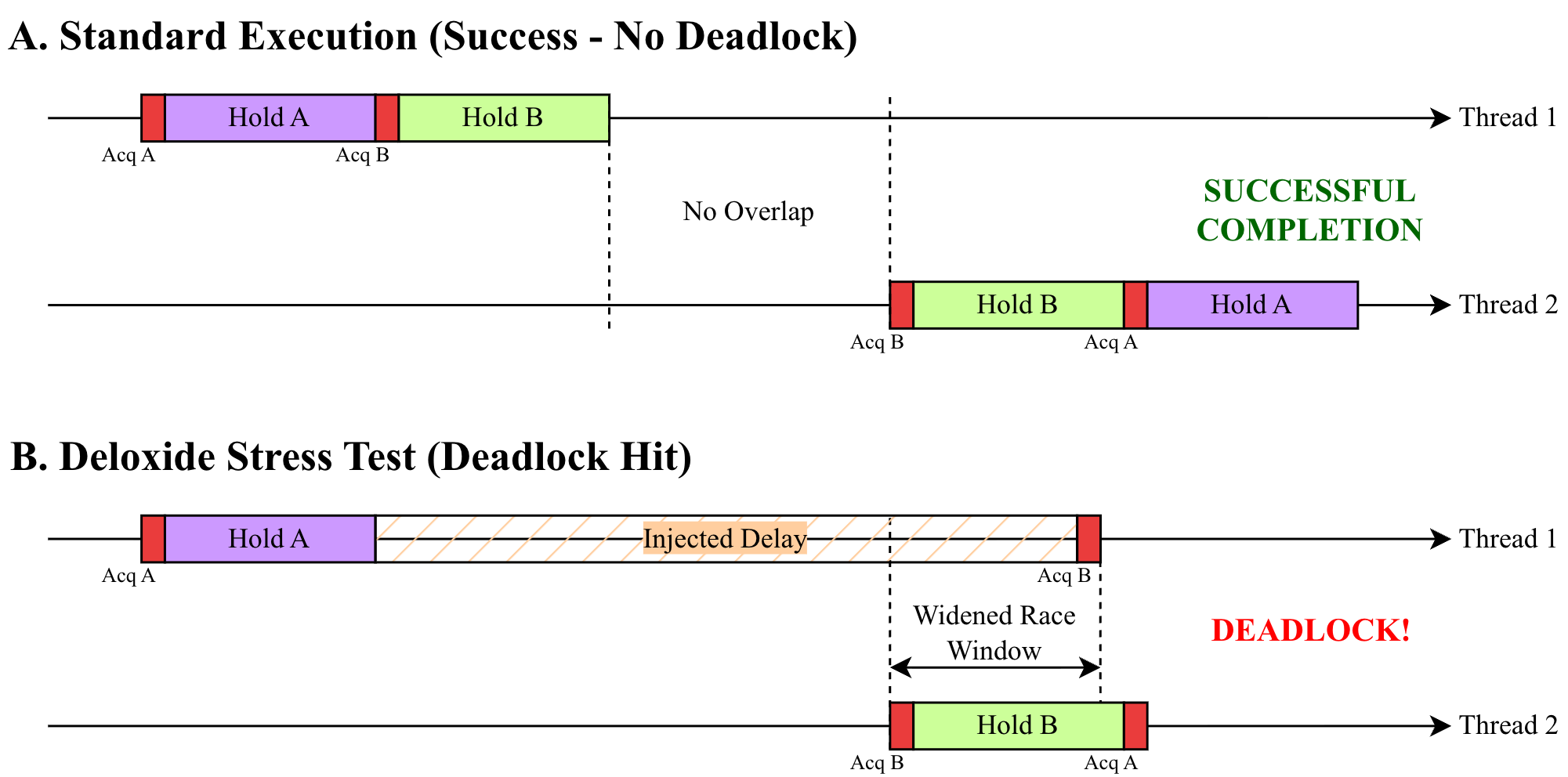
The delay does not create an impossible dependency. It widens a valid scheduling window that the application can already reach. Once the circular wait exists, Deloxide’s active detector reports the participating threads and locks through the configured callback.
[dependencies]
deloxide = { version = "1.1.0", features = ["stress-test"] }
Choose a stress mode
Random mode samples a delay before a lock acquisition when the thread already holds a tracked lock:
#![allow(unused)]
fn main() {
extern crate deloxide;
use deloxide::Deloxide;

Deloxide::new()
    .with_random_stress()
    .start()
    .expect("detector initialization");
}
Component mode learns held-lock/acquisition relationships and preferentially delays paths in the same component or reverse order:
#![allow(unused)]
fn main() {
extern crate deloxide;
use deloxide::Deloxide;

Deloxide::new()
    .with_component_stress()
    .start()
    .expect("detector initialization");
}
Both with_random_stress and with_component_stress select the default StressConfig if no configuration has been supplied. Set the mode as well as the configuration: with_stress_config alone supplies parameters but does not enable a stress mode.
Configure the disturbance
#![allow(unused)]
fn main() {
extern crate deloxide;
use deloxide::{Deloxide, StressConfig};

Deloxide::new()
    .with_random_stress()
    .with_stress_config(StressConfig {
        preemption_probability: 0.7,
        min_delay_us: 200,
        max_delay_us: 1_500,
        preempt_after_release: true,
    })
    .start()
    .expect("detector initialization");
}
preemption_probability is the chance (0.0 through 1.0) that random mode chooses a pre-acquisition delay. min_delay_us and max_delay_us bound that sampled delay in microseconds. preempt_after_release yields after tracked lock release; it is a scheduler yield, not an additional timed sleep.
Start low to keep ordinary tests quick, then increase only a focused reproduction:
#![allow(unused)]
fn main() {
extern crate deloxide;
use deloxide::{Deloxide, StressConfig};

let gentle = Deloxide::new()
    .with_random_stress()
    .with_stress_config(StressConfig::gentle());

let aggressive = Deloxide::new()
    .with_component_stress()
    .with_stress_config(StressConfig::aggressive());

let _ = (gentle, aggressive); // call start() in the isolated test process
}
StressConfig::gentle uses lower probability and shorter delays; StressConfig::aggressive increases both. Keep min_delay_us <= max_delay_us and record the exact four fields beside each failure.
A reliable reproduction loop
- Make the competing threads reach the intended acquisition point with a barrier or channels. Do not use a sleep to create the bug; use a sleep only inside the configured stress disturbance.
- Run the scenario in a separate test process (or otherwise disposable process). Deloxide initialization is process-wide, and an intentional deadlock must not strand the main test runner.
- Give the parent a hard timeout. On timeout, collect thread stacks, the callback payload, and the event log before terminating the child.
- Have the parent classify every launched attempt before calculating a manifestation rate. Count an active
WaitForGraphcallback received before the deadline as a detection. Count a child that exits without that callback, and a timeout with no such callback, as no active detection. The rate isactive detections / all attempts classified as detection or no detection; exclude only harness infrastructure failures, and report those failures separately with the launched-attempt count. A potentialLockOrderViolationcallback is not an active detection. - Save the test-case seed, scheduler/input seed, attempt number, platform, feature set, and complete
StressConfig. Deloxide currently draws stress randomness from its runtime RNG and exposes no seed-setting API, so record and control the surrounding harness seed when replayability matters.
The revalidated results chart is useful for comparing configurations, but it is not a promise that a particular machine or run will find the same defect:
Use it to choose a budget for reproduction, then validate a fix with deterministic synchronization and normal tests. Stress may turn a potential LockOrderViolation into an active WaitForGraph report, but failure to do so only means the tested schedules did not manifest the cycle.
Troubleshooting by Symptom
Start by deciding whether the expected outcome is an active WaitForGraph callback or a potential LockOrderViolation. A hang with neither can be contention, a missed notification, I/O, starvation, or an untracked synchronization path.
| Symptom | Likely cause | Confirming check | Next action |
|---|---|---|---|
| No callback fires | No active cycle exists, a raw/third-party lock is outside Deloxide, or the test never reached the contested acquisition. | Add barriers and record lock attempts; capture stacks; verify every relevant primitive is a Deloxide wrapper. | Review non-cycle hangs and make the callback explicit with Deloxide::callback. |
| Callback fires but no log exists | Logging feature/path is absent, disabled, or unwritable; callback delivery does not require a log. | Check the logging-and-visualization feature and the configured with_log path. | Preserve the callback payload now; enable a writable timestamped log path for the next run. |
| Visualization opens an empty or stale log | The wrong file was selected or buffered entries were not the active log when it was opened. | Confirm the configured log path and call showcase_this, which flushes the active log first. | Use showcase_this() for the current run, or showcase with the exact completed file. |
| Only lock-order findings appear | The order graph saw an inversion, but the tested schedule has not produced concurrent blocking. | source is LockOrderViolation and lock_order_cycle is Some(...); there is no active WaitForGraph. | Follow lock-order triage; reproduce under stress without calling it an outage yet. |
| RwLock report includes the same thread | A thread held a read guard and requested a write guard on that same RwLock. | Map the report’s (thread, lock) pair and inspect guard lifetimes around RwLock::write. | Release the read guard and revalidate before writing; see read-to-write self-deadlock. |
| Condvar test hangs without a cycle | A missed notification, false predicate, or external wait is blocking progress rather than tracked lock ownership. | Log predicate changes, wait registration, and notification order; use a parent watchdog. | Use the predicate loop and notifier protocol in Condvar wait and mutex reacquisition. |
| Benchmark overhead is higher than expected | Optional logging, lock-order checking, or stress mode changed the measured feature set/workload. | Print Cargo features and configuration; compare the same scenario with no_lock_order_checking, no logging, and no stress. | Benchmark the exact production feature set; keep stress out of production measurements. |
| Second initialization appears ignored | Rust initialization is process-wide; the first callback/configuration remains installed. C deloxide_init also returns 1 once already initialized. | Locate the first Deloxide::start or C initialization call in the process. | Configure once before workers start; use an isolated process for configurations that must differ. |
| C thread relationships are missing | Worker threads were created without the tracked thread wrapper/registration, or were not registered before using tracked locks. | Check that each pthread uses DEFINE_TRACKED_THREAD and CREATE_TRACKED_THREAD, or calls deloxide_register_thread_spawn/deloxide_register_thread_exit. | Follow the C guide and register the parent-child relationship before lock activity. |
When escalating an issue, attach source, the full DeadlockInfo payload, the test command and feature set, relevant thread stacks, and the exact log file if enabled. That evidence lets another engineer distinguish an active cycle from a potential ordering pattern without reproducing the entire production workload first.
C guide
Rust is Deloxide’s primary interface, but C applications can use the same
detector and tracked synchronization through include/deloxide.h.
Build and link
Build the library and C API:
cargo build --release --features c-api
Add other features when needed:
cargo build --release --features \
  c-api,logging-and-visualization,lock-order-graph,stress-test
Include include/deloxide.h and link the produced static or dynamic deloxide
library. Exact filenames and platform libraries depend on the target. The
repository’s c_examples/basic_mutex.c is the
smallest buildable example.
Initialization and callback
Initialize once before creating tracked objects:
#include "deloxide.h"
#include <stdio.h>

static void on_deadlock(const char *json) {
    fprintf(stderr, "Deloxide report: %s\n", json);
}

int main(void) {
    int rc = deloxide_init(NULL, on_deadlock);
    if (rc != 0) {
        fprintf(stderr, "deloxide_init failed: %d\n", rc);
        return 1;
    }

    /* create locks and threads */
    return 0;
}
The callback receives a borrowed NUL-terminated JSON string. Copy it if another thread must retain it; do not free it or keep the pointer after the callback returns. Keep callback work bounded.
Initialization returns 0 on success and 1 if it has already run. Invalid log
paths and logger failures use negative codes. Passing a non-null log path without
the logging feature returns -3; the public header currently omits that code.
Mutex
void *mutex = deloxide_create_mutex();
if (mutex == NULL) return 1;

if (deloxide_lock_mutex(mutex) != 0) return 1;
/* protected work */
if (deloxide_unlock_mutex(mutex) != 0) return 1;

deloxide_destroy_mutex(mutex);
LOCK_MUTEX(mutex) and UNLOCK_MUTEX(mutex) provide checked convenience macros
that terminate on failure. Destroy a mutex only after every thread has stopped
using it.
RwLock
void *state = deloxide_create_rwlock();
if (state == NULL) return 1;

if (deloxide_rw_lock_read(state) != 0) return 1;
/* read shared state */
if (deloxide_rw_unlock_read(state) != 0) return 1;

if (deloxide_rw_lock_write(state) != 0) return 1;
/* update shared state */
if (deloxide_rw_unlock_write(state) != 0) return 1;

deloxide_destroy_rwlock(state);
The RWLOCK_READ, RWUNLOCK_READ, RWLOCK_WRITE, and RWUNLOCK_WRITE macros
are the shorter checked form. A thread may hold read guards for different RwLocks,
but it must release each matching guard correctly.
Condition variables
A Deloxide condition variable waits with a Deloxide mutex:
void *mutex = deloxide_create_mutex();
void *ready = deloxide_create_condvar();

if (deloxide_lock_mutex(mutex) != 0) return 1;
while (!predicate_is_ready()) {
    int rc = deloxide_condvar_wait(ready, mutex);
    if (rc != 0) return 1;
}
if (deloxide_unlock_mutex(mutex) != 0) return 1;

deloxide_destroy_condvar(ready);
deloxide_destroy_mutex(mutex);
deloxide_condvar_wait_timeout returns 1 when the timeout expires and 0 when
notified. Negative values indicate invalid handles, a mutex not held by the
caller, or another wait failure. Notify with
deloxide_condvar_notify_one or deloxide_condvar_notify_all.
Tracked threads
Any native thread using a Deloxide lock contributes synchronization events. Register lifecycle events when logs should also show the thread relationship:
uintptr_t tid = deloxide_get_thread_id();
deloxide_register_thread_spawn(tid, parent_tid);

/* thread work */

deloxide_register_thread_exit(tid);
On POSIX, DEFINE_TRACKED_THREAD(worker) and
CREATE_TRACKED_THREAD(thread, worker, arg) wrap this protocol around
pthread_create. Those macros are not available on Windows; call the manual
registration functions from the Windows thread entry point.
Logging, visualization, and stress
With logging-and-visualization, pass a log path to deloxide_init, flush it
with deloxide_flush_logs, and open it with deloxide_showcase or
deloxide_showcase_current.
With stress-test, C can enable random scheduling delays with
deloxide_enable_random_stress, enable targeted component delays with
deloxide_enable_component_stress, and return to normal scheduling with
deloxide_disable_stress.
The C header is the exact API reference. This chapter focuses on correct lifecycle and common usage rather than duplicating every status-code comment.
Operate Deloxide in Production
Deloxide is most useful when its configuration, its coverage, and its incident
path are decided before an outage. Begin with the default active wait-for
detector, then add optional evidence features only after measuring their cost in
the workload that will run them. An active WaitForGraph report is evidence of a
validated cycle among supported, tracked synchronization; a
LockOrderViolation is a potential historical ordering risk and needs a
different response. See Reading a Deadlock Report for
the triage distinction.
Roll out in stages
- Inventory the coverage boundary. List every process, thread entry point,
long-lived worker, and lock instance that matters to the service. Migrate
those lock instances to Deloxide
Mutex,RwLock, andCondvarwrappers. Preferdeloxide::thread::spawnordeloxide::thread::Builderwhere parent/child and exit events are useful. Record rawstd::sync, rawparking_lot, third-party, and operating-system synchronization as explicit gaps; a cycle that crosses one is not fully visible to the detector. - Canary the default build first. Initialize one process-wide detector before creating tracked locks or accepting work. Install an explicit bounded callback, observe startup errors and report volume, and verify that normal lock behavior and service latency stay within the application’s budget.
- Benchmark representative work before broad rollout. Include production contention shapes, RwLock reader/writer ratios, request concurrency, CPU limits, and the exact Cargo feature set. The focused figures in Measure Performance are a starting point, not capacity planning for another workload or machine.
- Add optional features one at a time. Enable logging for a controlled incident capture, lock-order analysis in development or CI, and stress modes for focused reproductions. Measure each addition separately and again in the combined configuration if it will be deployed together.
Deloxide::start() configures global process state, not a worker-local detector.
The first installed callback and logger persist; later starts are partial
reconfiguration rather than a reliable reset. Use separate processes to compare
clean configurations or isolate test cases. The lifecycle chapter explains the
feature-specific repeated-start behavior in detail: Manage Lifecycle and
Callbacks.
Make the callback an alert handoff
Callbacks run on a single dispatcher outside the detector mutex. They are a poor place to acquire an application lock, synchronously page an external service, open a browser, or attempt an involved shutdown: any of those can delay later reports or entangle an already blocked application. Transfer the report to a bounded application-owned queue, count failed handoffs, and let a supervisor perform slower enrichment, persistence, tracing, or paging.
#![allow(unused)]
fn main() {
extern crate deloxide;
use deloxide::{DeadlockInfo, Deloxide};
use std::sync::{
    Arc,
    atomic::{AtomicU64, Ordering},
    mpsc,
};

let (reports_tx, reports_rx) = mpsc::sync_channel::<DeadlockInfo>(64);
let dropped_reports = Arc::new(AtomicU64::new(0));
let callback_drops = Arc::clone(&dropped_reports);

Deloxide::new()
    .callback(move |report| {
        if reports_tx.try_send(report).is_err() {
            callback_drops.fetch_add(1, Ordering::Relaxed);
        }
    })
    .start()
    .expect("initialize before instrumented work");

// A separate task owns reports_rx and may persist or page without an implicated lock.
let _incident_inputs = (reports_rx, dropped_reports);
}
This code deliberately drops a report when the queue is full or disconnected. Choose queue capacity, overload telemetry, and supervisor durability for the incident burst the application expects. A process can still abort or be killed before the callback, logger, or supervisor finishes; test evidence preservation on the normal incident path instead of treating a callback as a transaction.
Capture, protect, and retain logs
The logging-and-visualization feature adds an asynchronous event logger. With
that feature compiled, Deloxide::new().start() selects deloxide.log unless
the builder uses with_log; the writer creates parent directories and truncates
an existing selected file. Give each process or incident a unique,
application-owned path that includes a PID, UUID, or another collision-proof
component. The built-in {timestamp} substitution has one-second precision, so
logs/deloxide_{timestamp}.log reduces collisions but is not sufficient to make
concurrent process paths unique. Apply permissions, encryption, storage limits,
retention, and access review as you would to any incident record. Do not let
multiple processes reuse one filename.
The current optional logger has an unbounded ordinary-event queue. The correctness hardening report records that choosing a bounded drop, block, or coalescing policy still needs a separate saturation design and test. Accordingly, treat logging as incident evidence with memory and I/O capacity to monitor, rather than as a lossless audit trail with a fixed resource bound.
When an incident requires the timeline, flush and open the process’s current log
from a controlled supervisor path with showcase_this, or use showcase for a
retained file. The viewer encodes the local log in a URL and opens
https://deloxide.vercel.app/ in the default browser. Review the log for
identifiers or sensitive context before sending it to that browser destination;
this workflow does not provide a local-only guarantee. Keep the structured
callback report as the primary alert input and the visualization as supporting
reconstruction evidence. Logging and Visualization
describes the file format and failure cases.
Roll back by feature and preserve the evidence boundary
Cargo features are compile-time choices, so a rollback normally means deploying a binary built without the optional feature, not flipping a runtime switch in a running process.
| Observation during rollout | Narrow rollback | What remains |
|---|---|---|
| Log volume, file I/O, or queue growth is unsuitable | Deploy a build without logging-and-visualization, or use no_logging() before the first successful logger installation. | The default active detector and callback remain available. |
| Historical order warnings create more work than the team can triage | Deploy without lock-order-graph, or use no_lock_order_checking() for the initial start. | Active WaitForGraph reporting remains; do not reinterpret its evidence as an order-graph result. |
| Test perturbation changes timing too much | Deploy without stress-test and remove stress-builder selection. | The normal active detector path remains. |
| Base detector cost or behavior fails the service’s own acceptance criteria | Roll back the Deloxide integration or confine it to the reproduction environment. | Existing application observability must cover the incident instead. |
Do not use a second start() call as an in-process rollback. It does not clear
existing ownership and wait state coherently, cannot replace the first callback
or logger, and has feature-specific side effects.
Deployment checklist
- The process initializes exactly one intended Deloxide configuration before instrumented work begins.
- The coverage inventory names tracked lock instances, thread entry points, and every known untracked synchronization boundary.
- The callback only performs bounded, nonblocking handoff; its queue loss or disconnection metric is monitored.
- The service has separate response playbooks for active
WaitForGraphand potentialLockOrderViolationreports. - A representative benchmark covers the deployed features, contention pattern, resource limits, and roll-back threshold.
- Logging paths are unique per process/incident, writable, access-controlled, retained for an agreed period, and sized with the unbounded queue caveat in mind.
- The visualization export/privacy review is part of the incident procedure.
- Lock-order and stress features are enabled only in the environments where their historical-analysis or schedule-perturbation costs are intended.
- A fresh process/binary is available for each rollback configuration; no
response depends on repeated
start()calls.
Performance and benchmarks
Deloxide was evaluated with lock microbenchmarks, heavily contended workloads, correctness controls, stress-driven manifestation tests, and a shared-state raytracer. The complete study is described in the preprint “Deloxide: Low-Overhead Real-time Deadlock Detection and Visualization Framework for Rust”.
The full cross-tool benchmark suite has not been rerun for 1.1. A focused 1.1 microbenchmark checks whether the correctness fixes changed the default fast path. It is a no-regression check, not a replacement for the full evaluation.
Abbreviations:
- STD:
std::sync; - PL+DD:
parking_lotwithdeadlock_detection; - ND:
no_deadlocks; - DX: Deloxide default;
- DX (LOG): Deloxide logging and visualization; and
- DX (COMP): Deloxide component-based stress mode.
What was tested
The evaluation separates five questions:
- Primitive cost: how much latency does tracking add to an isolated lock operation?
- Contended throughput: how do the implementations behave from 4 to 64 competing threads?
- Correctness: do deterministic cycles produce reports, and do nine complex safe patterns remain free of active WFG reports?
- Manifestation: how often does each scheduling strategy make a timing-sensitive deadlock occur?
- Application impact: what happens in a raytracer with 8 workers and 129,600 critical sections per 1080p frame?
These measurements should not be collapsed into one number. Stress mode is supposed to slow and perturb a test. The production-oriented comparison is the default fast path.
Lock microbenchmarks
| Metric | STD | PL+DD | DX | DX (LOG) | DX (COMP) | ND |
|---|---|---|---|---|---|---|
| Mutex lock | 8.7 ns | 9.9 ns | 10.8 ns | 58.1 ns | 229.4 ns | 10,527 ns |
| RwLock write | 10.1 ns | 12.8 ns | 13.9 ns | 57.7 ns | 234.1 ns | 10,797 ns |
| RwLock read | 13.9 ns | 16.1 ns | 62.4 ns | 85.5 ns | 222.5 ns | 10,895 ns |
| Condvar | 17.1 µs | 17.2 µs | 19.6 µs | 17.4 µs | 20.3 µs | 2,100 µs |
Default Deloxide stays close to the primitive baselines in the focused Mutex, write-lock, and Condvar cases. RwLock reads cost more because Deloxide must count live readers for later writer dependencies. Logging adds event construction and queueing. Component stress adds intentional delay and should never be interpreted as production overhead.
Contended workloads
The macrobenchmarks measure complete workloads rather than one lock operation. The producer-consumer test is write-heavy; the concurrent-read test exercises shared RwLock access.
| Producer-consumer | PL+DD | DX | DX (COMP) | ND |
|---|---|---|---|---|
| 4x4 threads | 0.22 ms | 0.28 ms | 29.7 ms | 98,000 ms |
| 16x16 threads | 1.25 ms | 1.81 ms | 122.0 ms | Timeout |
| 64x64 threads | 7.60 ms | 20.2 ms | 488.6 ms | Timeout |
| Concurrent reads | PL+DD | DX | DX (COMP) | ND |
|---|---|---|---|---|
| 4 threads | 0.33 ms | 0.37 ms | 10.7 ms | 25.1 ms |
| 16 threads | 3.2 ms | 1.6 ms | 87.1 ms | Timeout |
| 64 threads | 13.9 ms | 10.6 ms | 356.6 ms | Timeout |
The default path follows PL+DD closely at low contention. It costs more in the write-heavy 64x64 case and is faster in the read-heavy 16-thread and 64-thread cases. These results describe the tested workloads, not a universal ranking.
Raytracing workload
The application benchmark uses a shared, tile-based framebuffer. At 1920×1080, workers perform 129,600 lock acquisitions per frame while tracing a scene with a maximum recursion depth of 50.
| Configuration | 426×240 | 854×480 | 1280×720 | 1920×1080 |
|---|---|---|---|---|
| STD | 0.81 s ± 0.03 | 3.41 s ± 0.15 | 7.33 s ± 0.31 | 17.22 s ± 0.65 |
| PL+DD | 0.81 s ± 0.00 | 3.26 s ± 0.02 | 7.19 s ± 0.03 | 18.32 s ± 0.06 |
| DX (default) | 0.80 s ± 0.00 | 3.18 s ± 0.01 | 7.09 s ± 0.03 | 16.67 s ± 0.09 |
| ND | 33.0 s ± 31.4 | 220.9 s ± 182 | 192.9 s ± 281 | 329.1 s ± 554 |
In the full evaluation, Deloxide completed the 1080p workload 9% faster than PL+DD. Detection does not inherently make an application faster; the result reflects the complete lock implementation and the workload’s contention shape.
Stress-testing manifestation
Each method ran the same deliberately deadlocking scenarios repeatedly without barriers. This measures whether the schedule forms the deadlock, not whether a detector can recognize a cycle that already exists.
| Scenario | PL+DD | ND | DX passive | DX component |
|---|---|---|---|---|
| Two-lock cycle | 25% | 74% | 17% | 99% |
| Three-lock cycle | 77% | 99% | 88% | 100% |
| Five-lock cycle | 100% | 99% | 100% | 100% |
| Dining philosophers | 54% | 76% | 40% | 99% |
| RwLock cycle | 60% | 100% | 41% | 100% |
| Average | 63.2% | 89.6% | 57.2% | 99.6% |
The component strategy’s purpose is to make latent schedules appear during testing. These percentages are manifestation rates for the evaluated scenarios, not a claim that every real-world deadlock will reproduce.
Correctness and safe-pattern controls
With barriers enabled, Deloxide, PL+DD, and ND detected every deterministic ground-truth cycle in the evaluated suite. A separate set of nine deadlock-free programs checked whether the runtime WFG confused safe synchronization with an active cycle.
| Category | Scenario | What it checks |
|---|---|---|
| Architectural | gate_guarded_fp | Hold-and-wait avoided by a coordinator |
| Architectural | producer_consumer_fp | Unidirectional shared-queue flow |
| Temporal | lock_free_interval_fp | Long lock-free intervals and stale state |
| Temporal | lock_order_inversion_fp | Inversion serialized by an atomic signal |
| Hierarchy | four_hier_fp | Strict global lock ordering |
| Hierarchy | thread_local_hierarchy_fp | Disjoint per-group hierarchies |
| Hierarchy | complex_lock_order_fp | Cyclic history serialized by phase barriers |
| Semantics | read_dominated_fp | Safe shared-read cycles |
| Semantics | conditional_locking_fp | Common coordinator lock |
The active WFG produced zero reports across these nine safe patterns. The predictive lock-order graph flagged two patterns as potential risks, which is expected because it analyzes acquisition history rather than current waits. These are empirical results for the tested patterns, not a proof about every possible program.
Five representative safe-pattern workloads were also timed:
| Scenario | PL+DD | DX | ND |
|---|---|---|---|
| Conditional locking | 24.46 s | 24.86 s | 654.32 s |
| Thread-local hierarchy | 23.39 s | 24.15 s | 318.44 s |
| Read dominated | 1.69 s | 1.82 s | 19.30 s |
| Producer-consumer | 0.57 s | 0.62 s | 14.09 s |
| Four hierarchy | 0.62 s | 0.61 s | 11.73 s |
Focused 1.1 no-regression check
The current 1.1-focused Criterion run used 30 samples, a one-second warmup, and a two-second measurement window on an Apple M1 Pro:
| Operation | Median | 95% interval |
|---|---|---|
| Deloxide Mutex, uncontended | 9.12 ns | 9.07 to 9.22 ns |
parking_lot Mutex, uncontended | 10.28 ns | 9.95 to 10.50 ns |
| Deloxide RwLock write, uncontended | 9.17 ns | 9.08 to 9.21 ns |
| Deloxide RwLock read, uncontended | 58.07 ns | 54.06 to 62.78 ns |
| Deloxide Mutex, two-thread handoff | 37.89 µs | 37.12 to 39.03 µs |
The Mutex result is faster than the earlier Deloxide microbenchmark and the same-harness PL+DD point. The run is too short and narrow to support a general performance claim. Its purpose is to show that the latest correctness fixes did not introduce material default fast-path overhead.
Reproducing the evidence
The repository’s evaluation record contains the current commands, toolchain, commits, raw CSVs, and paired-seed controls.
Benchmark on the hardware, feature set, contention topology, and workload you plan to ship. Microbenchmarks establish mechanism cost; only the application can establish production impact.
Why Deloxide
The Rust ecosystem offers several approaches to concurrency safety, each with different trade-offs. Deloxide is built to bridge the gap between lightweight but passive monitoring and heavyweight synchronous debugging.
The landscape
Static analysis checks code before it runs. It can find useful ordering problems early, but complex path and concurrency assumptions can produce noisy results. It also cannot reconstruct the runtime schedule that produced an incident.
Passive dynamic detection, such as a periodic parking_lot deadlock check,
keeps normal lock operations fast. Because observation happens later and the
detector does not perturb scheduling, timing-sensitive bugs may fail to manifest
or may only be reported at the next polling interval.
Synchronous graph analysis, represented in the evaluation by
no_deadlocks, updates a global model around lock operations and finds cycles
immediately. The full evaluation shows why that approach is normally
treated as a debugging configuration rather than an always-on production path.
Deloxide combines synchronous active detection with an Optimistic Fast Path. Eligible uncontended Mutex and exclusive RwLock operations avoid global graph work, while contended operations publish the evidence needed for a current wait-for cycle. Optional features add predictive lock-order analysis, schedule stress, logging, and visualization only when the investigation needs them.
Feature matrix
| Feature | STD | PL+DD | ND | DX |
|---|---|---|---|---|
| Mutex overhead | 0.88× | 1.00× | 1063.33× | 1.09× |
| Raytracing at 1080p | 0.94× | 1.00× | 17.96× | 0.91× (faster) |
| Detection method | None | Async (poll) | Synchronous | Synchronous (instant) |
| Lock-order analysis | No | No | No | Yes |
| Stress testing | No | No | No | Yes |
| Visualization | No | No | Text dump | Interactive URL |
| False-positive rate in evaluated WFG controls | N/A | Zero | Zero | Zero |
STD = std::sync, PL+DD = parking_lot with deadlock_detection, ND =
no_deadlocks, DX = Deloxide. Ratios and observed false-positive results are from
the full evaluation.
What Deloxide adds
Deloxide covers the full lifecycle of a concurrency defect:
- Development: lock-order analysis finds dangerous inversions before they block a run.
- Testing: random and component-based stress modes make rare schedules substantially easier to manifest.
- Diagnosis: active WFG reports identify the participating threads and waited locks immediately.
- Response: custom callbacks can record evidence, send alerts, export telemetry, or notify an application supervisor.
- Investigation: structured logs become an interactive execution timeline and dependency graph.
- Production: the Optimistic Fast Path keeps the default detector close to primitive-baseline cost in the evaluated workloads.
- Integration: Rust applications get guard-based wrappers and C applications use the same detector through the shipped header.
That combination is Deloxide’s selling point. It is not only another lock implementation and not only a post-hoc deadlock check; it is one toolkit for finding, reproducing, explaining, and monitoring the bug.
The detailed methodology and results are in Performance and benchmarks and the Deloxide preprint.